
Lets start by saying there are no objective measurable or consistent agreements across the art on standards for each belt. Some gyms believe in doing testing to a curriculum, some do stripes, some don’t, some only at white and blue and others insert another belt between white and blue. To each their own. My opinions are based on my experiences, my coach, and my personal ideas on what the art is to me and what a belt FROM ME means.
That’s important, the FROM ME part. The belt is not just a rank or a symbol of who you can submit its a tie between the giver and the receiver and represents the connection between them. For those people we have all seen selling a belt and associations the tie between them is clearly money. I don’t pay my bills with jiujitsu, you can’t buy one from me.
Secondly, there are pros and cons to even having a belt system. They can be useful to mark experience level for competition, to signify knowledge levels for instruction, and are personally meaningful between the individual and their coach and team. Often times a belt or a stripe is recognition of hard work, of knowing your coach and your team sees the results of the effort you put in, and that in itself can be worth dealing with the downsides such as comparing oneself to others, jealousy, and feelings of entitlement. You may think this is easy for me to say since I got my black belt, but I wasn’t born a black belt. I’ve seen people I could beat get promoted before me, I smashed smaller people who got stripes before me at blue belt then felt bad about it. I too have wondered what more I need to do to get to the next level. But once you get to Black Belt I look back and realize all of that was just me learning about me, and now the only thing that matters is my own journey and the training. I’ve said it many times, if there where no belts I would still be training. The belt is not the goal, its the byproduct.
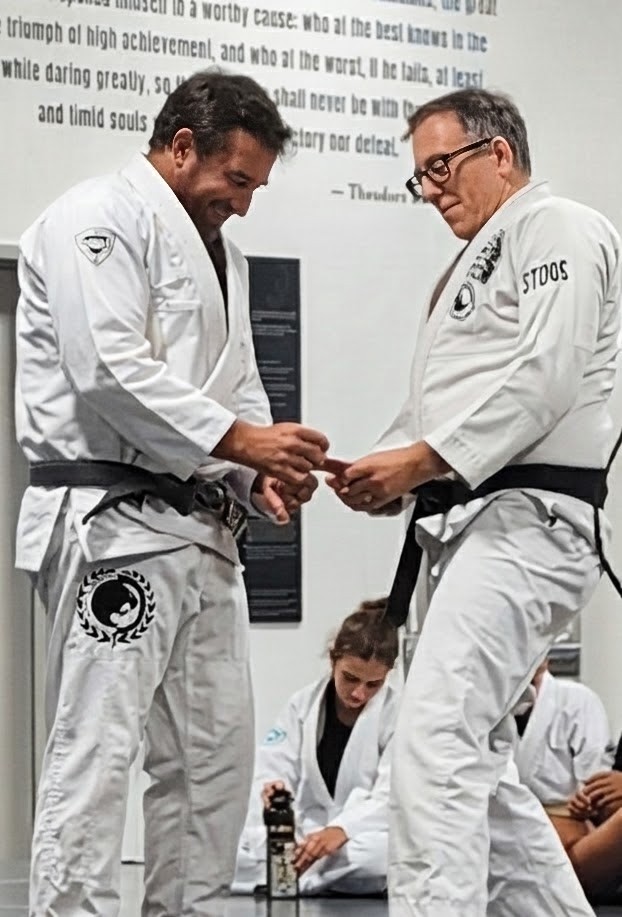
I recently got my first degree on my black belt from Warren Stout / Stout Pittsburgh Team Renzo Gracie , I moved from Pittsburgh a year ago, haven’t paid a membership since but he’s still my coach. I got all my belts from Warren and he’s stuck with me. I have the best coach for me, I suggest you feel the same about yours or find a new one.
White Belt – 3rd stripe
Our school went from tiny to large to massive in the time I was there since the beginning in the OG days in Lawrencville. No real shower, no sauna, no full time instructors but Warren. The halcyon days when the sweat fogged up the windows, when we started live rounds in standing rear body locks and have no idea how we survived. Stripes on white belts meant something, and we fought tooth and nail to get the next step up the ladder. The third stripe meant you could attend intermediate classes and open mats. We always did live positional sparring in Fundamentals, but open mat was the biggest deal. To be able to go in and just roll, music playing, laughter. That’s where the cool kids were. Third stripe is the key to get in.
For me that third stripe means you’ve been regularly attending classes, that you TRY to do the techniques we show you, and that most of all I can trust you to some degree to train without supervision that you wont hurt yourself or your training partner. We always kept a close eye in Fundamentals and constrained the positional sparring such that the risks are minimized. But open mat is the wild west and I cant open that door to someone who throws themselves wildly through space and breaks their own legs for no good reason.
It doesn’t mean you beat up the other white belts, doesn’t mean your better than a 2 stripe, its trust, faith, and an invitation to train more.
Blue Belt
I might say my standard here may be less performance based than my peers. I have promoted a few blue belts ahead of when others have. The blue belt is is an easy upgrade to me. It means I can train with them and they have enough understanding of the fundamental positions that they will give me good responses. They don’t stick their arms in triangles unprompted, they try to get in frames, they work towards the main submissions when in dominant positions. They try to perform the main moves from the fundamental positions, and I want to leg lock them. I don’t want to leg lock white belts. Once I start thinking I should throw an ankle lock on them and start giving them more pressure I give them a green light… errrrrr…. I mean….. blue belt.
Blue belt means I can train with you now. Your ready to start.
Purple Belt
“Your in it now” – Justin Kerestes
Yeah, Purple Belt is no small deal. It takes dedication and years of getting beat up as a blue belt to get there. A good purple belt can catch anyone. They have started to develop their own game, have their own preferences and favorite sequences. That may change but they have learned the ability to focus and the power of specialization. They have a feel for an arm bar, mount attacks, a guard of some type and are ready to go deep on it.
One litmus test my coach always said is a purple belt must be a legitimate threat to a black belt from guard. There are plenty of people with strong wrestling or other grappling backgrounds that can beat people higher ranked or even win competitions with those skills, but the differentiating aspect of jujitsu is the bottom game, in positions that would be losing in other sports the jujitsu player has offence. You do not need to succeed in the sweeps and submissions but you must be dangerous there and a real threat. If your game goes to nothing once you hit your back we have work to do.
Purple belts are ready to teach, and should do so. Few things are so good for development as teaching.
Purple belts should not gas out after a couple rounds of open mat, they should be able to train for extended periods (outside of physical limitations, illness) without issue.
Purple belt was a long journey for me, I want to know the person I’m giving one too is ready to undertake it. This is moving past the beginner stages, you should know how to train, how to improve, and be able to step into tough rooms with expectations.
I wrote extensively on this when I got my purple belt in 2017.
Brown Belt
The person ready for their Brown Belt has learned deep through Purple Belt. They have strong fundamentals. They have favorite positions and techniques but no major weaknesses. I look for what I’ll call “quality of movement”. Like a fine watch or a piece of art the movement should show refinement of the craft and grace. Transitions should be smooth, and timing should be the focus.
Brown belts should be able to feel heavier than they are, control their pace, and understand their own body.
The Brown Belt must have an understanding of both strategy and tactics and be able to articulate those to some degree. A simple example of that may be as straightforward as “I felt my opponents half guard position was strong so I decided to post on them to get to standing passing positions.” It doesn’t need to be in depth breakdowns of ADCC matches but even MAKE SMASH NO LIKE LEG LOCK is a strategy.
I’m not giving a Brown Belt to anyone I’m not certain can make it to Black. This is the time to get deep in your skill set and mature. The Brown Belt should be a mentor to the less experienced and key component of a gyms culture.
Black Belt
If you don’t stop training you will be a Black Belt longer than any other belt. It’s not the end of the journey, its not the gold star that you did it, good job, go rest on your laurels. When you train with people they will want to know if your blue or purple or brown but once you get to black they only want to know one thing “Are they any good?”. You’ve got a target on you and you need to be ready. People want to test themselves on you, impress you, or show you how good they think they are.
The Black Belt is not the goal, not the finish line. It’s a byproduct of the work. If there were no belts you would still be training, that is a must. It is the zen paradox of the thing for me that the desire for it as if it is a prize is toxic to the realization of the actual achievement.
The Black Belt above all loves jujitsu, and that’s why they train.
The Black Belt in my opinion symbolizes mastery of the craft. Warren said recently that skill and knowledge are often on separate trajectories but as black belt we expect them to come close to intersecting. The Black Belt is a mentor, a leader, and someone who can carry not just the art but the reputation of the person who awards it. There is an irrevocable tie between the giver and receiver.
I’m proud of who I got mine from, and I know he’s proud to have me represent him. I don’t take that lightly. I’ll carry that with me the rest of my life.
The Black Belt in my opinion does not need to be as good in gi or no gi but must have some understanding of both. If you never put the gi on traditionalists might say your not even doing Brazilian Jujitsu, but I’d ask what you even need the belt for if your not competing.
Finally, and this is personal, I got into jujitsu for self defense / fighting. My mentors have been people like Craig Douglas, Cecil Burch, Paul Sharp, Larry Lindenman. I would be embarrassed as a Black Belt if I didn’t have some fighting skills, and if I give one to someone I want to know that they have some understanding of the broader fighting arts. You don’t need to have an MMA record, or an amateur boxer, but some level of understanding of how to tuck your chin, cover your head, clinch and actually use that jujitsu in a real violent encounter is a must. I wouldn’t say I care one bit about that for anyone else, but if I’m tying that belt I need to know you have some understanding of violence. You are a representative of the art, and for me its a fighting art.
You’ll notice some stuff I didn’t mention.
I didn’t mention competing. I compete, not a lot but its part of my experience. If you need the belt in order to compete at an appropriate level that’s a secondary discussion outside the scope of this post.
I didn’t mention who beats who at open mat. Class is for learning and open mats are for training. Nobody ever won an open mat. Yes I expect a Brown belt to be able to beat a blue belt within the same division in a competitive round, but most training isn’t competitive. Its trying to get better, and trying to improve on things you are learning runs counter to trying to win a lot of the time.
I didn’t mention time in grade. Life happens, some people learn fast, others learn hard, and frankly if one person trains 3x a week and someone else trains 6x a week you cant be surprised when the 6x improves twice as fast. The “how long have you been training for?” question doesn’t account for actual mat hours and frankly if you’ve been at one belt a long time and aren’t improving I suggest reviewing your progress with your coach and creating an actionable plan to improve. That’s what you pay them for.
Performance among your PEERS. I did not mention but it should be understood that if you are moving from say blue to purple you should be outperforming the other blue belts BUT I want to be clear. This does not mean beating them up, ripping submissions, or never getting scored on. It is a general sense in which as a coach I can see that your knowledge of positions has grown beyond your peer group and you technical acumen is improved in comparison. That is not your open mat win/loss record (since that doesn’t exist) and needs to be observed over time. Your PEER group is people around your own age, weight, and experience. Being a 20 year old athletic specimen purple belt with no day job and submitting a 50 year old black belt with a busted knee that you have 30 pounds on who makes it in twice a week with a stressful job and a family isn’t proof of technical acumen. This isn’t some magic art such that strength, size, and youth don’t matter. We are physically imposing our will on a resisting human being, the body you do that with is part of the equation. As a coach if I want to measure your skill I need to find ways to isolate that variable. If a escape was not technically sound but only worked because of some physical attribute that’s great for you, and what works works, but it doesn’t help me measure skill and knowledge.
Something Paul Sharp once told me about strength was “Have as much as possible. Use as little as necessary.”
If I give you a belt I should feel comfortable with you walking into any training room in the world wearing that and so should you.
Finally something my coach said often. People who lower standards to give belts are like printing money, they reduce the value and meaning of the belt for everyone. We want ours to be the Gold Standard.
Shawn

