
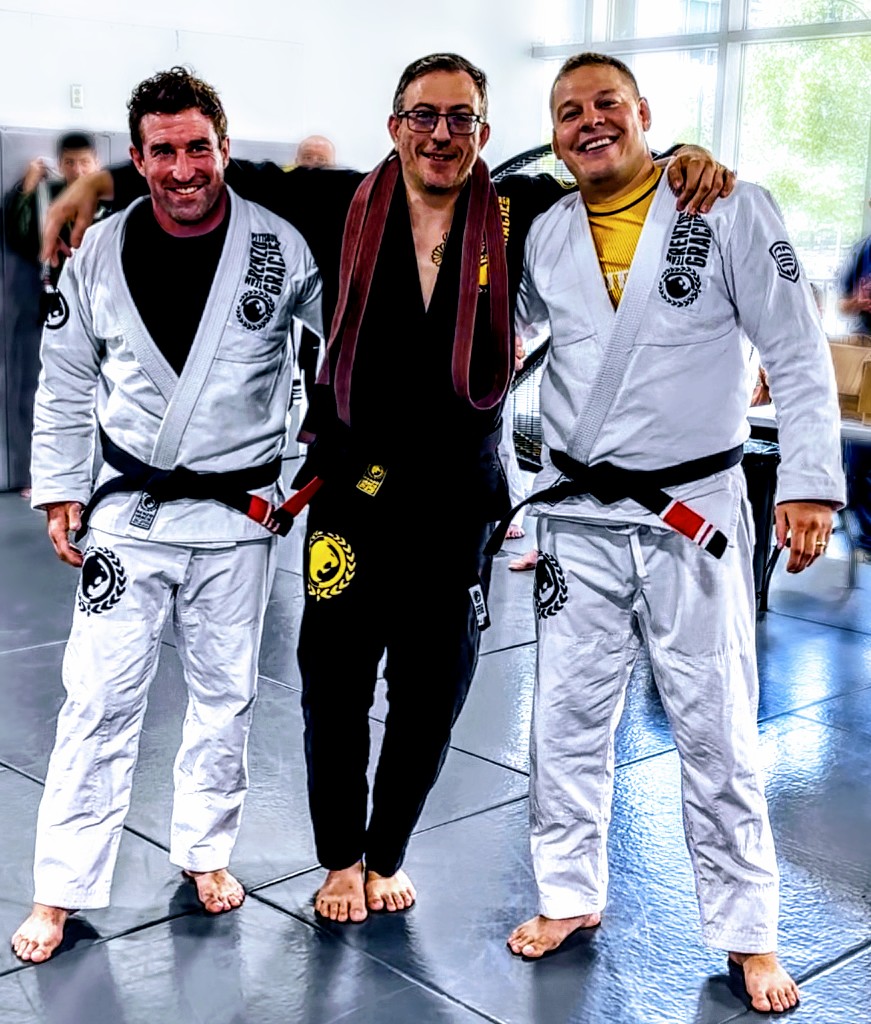
I recently earned by black belt in Brazilian Jiu Jitsu from my main coach and dear friend Warren Stout at Stout Training Pittsburgh / Team Renzo Gracie . If you want to watch the video and my speech you can find it here:
@antifragiletraining instagram
No I didn’t know I was getting it, but I wasn’t surprised either.
I won’t rewrite the things I said in my speech. Those are the high points for me and I’m glad I was able to express them in that moment. But there are some items I want to write out about getting to this point that I will share with any of the people out there odd enough to be readers of this very niche blog.
The first is this. Anything that keeps you engaged and on the mats is good. Point blank. I hear and have heard plenty of arguments for one style of training over another, or one path to progress over another. And I think especially with specific goals and time constraints those are valid. If you are a 16 year old and want to win ADCC one day there are definitely smart and efficient paths toward that goal by the time you start into your physical prime that would be different from starting at 50 and trying to get into better shape, or maybe thinking about self defense and attending a Shivworks ECQC . But just because some paths may lead more directly to certain goals within a time frame doesn’t mean other paths are invalid.
I have seen way too many “old school self defense” instructors who want to stay only within a very small curriculum, or who dismiss any trends or changes in the art. I think that is closed minded and short sighted. Sure, inverting into leg locks isn’t the best most practical topic for someone interested in self defense but if you never learn them your not likely to ever get to practice your smashing heavy top pressure game while you get submitted by some 120lb kid in unicorn spats at open mat. Further, if we start thinking about this as a lifetime of study, then if spending a year learning berimbolo just for fun keeps you on the mat and engaged in learning I’d say that’s miles better than not training at all. Any time spent on the mat engaged in learning and trying to control a resisting opponent is good time.
I didn’t want to be the leg lock guy. Really. I was deep on standing game and kimura study when a terrible cervical spine injury struck. For the next 9 months or so I came and watched classes and did endless double seated leg pummeling drills with my training partner Sage who also got his black belt when I did. I stayed engaged, I learned something new, I stayed on the mat and when I came back I was better than when I left.
I’ll be doing this for the rest of my life, if I decide to spend a year learning esoteric lapel nonsense its not really important if that’s relevant to self defense or competition in no gi. What matters is that it keeps me interested, curious, and involved in learning.
The other item I wanted to talk about was the evolution of my learning through brown belt. I wrote a post Purple Belt Thoughts when I hit purple about that process and how I got there. I still stand by that as a great guide for the “how to train” especially at that level. But brown belt I started to change. I became less of a technophile. When it came to techniques or moves yes I still wanted to see the new stuff, learn whatever the current meta is. But my own style? It became focused more on the small adjustments and the set ups. I started to learn what set ups lead to better entries and easier finishes. I found items I had great success with and made them stronger. I started a course of personal refinement.
Along the way I made some of my weaknesses into my strength. I always struggled with Arm Triangles since white belt. I decided that was not acceptable. Its a basic move of the sport. I started thinking things like how would I feel if I got a black belt one day and a new guy asked me about a arm triangle, or a arm bar, or some other fundamental technique and I didn’t understand it? No way. I studied, I watched video, I drilled, I did positional sparring, I sought out expert advice from my coaches. Now, you’d never know it was my worst submission a year ago and its my number one finish from top position.
But beyond that, what I feel made the biggest difference was that I started to really focus on the feel of a move. We all know what it feels like when a good black belt puts you bottom side or mount and they somehow get denser. How it feels like the attachment is unbreakable. I started to feel pressure differently. I began to think when I pass this personas guard I want them to feel what I feel when Warren passes mine. Daniel Gracie described it to me once like he felt like a sand bag, and he sinks into all the crevices. Anyone who has felt Daniels side control can tell you that’s an understatement.
I wanted to be able to feel my opponents lungs, to be so connected that I could breathe into their diaphragm and take their breath from them. There is no technique I can point to, no specifics of where my body sits that will communicate it. I am convinced that learning how to intuitively use your weight is a deep skill of grappling that is only found through time and experience. I know what a black belt feels like on top of me, and it has become meaningful to me to let other people know that feeling too. Not to smash them or be cruel, but so they can find that feeling as well. Your welcome.
No place I’d rather be.
 Antifragile Training